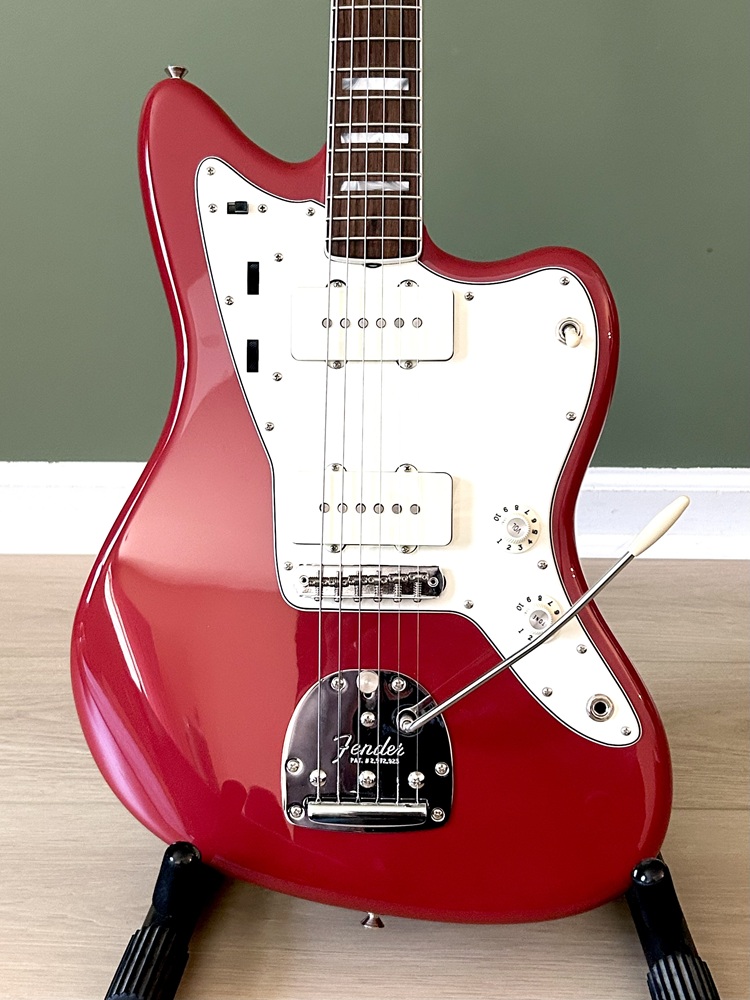
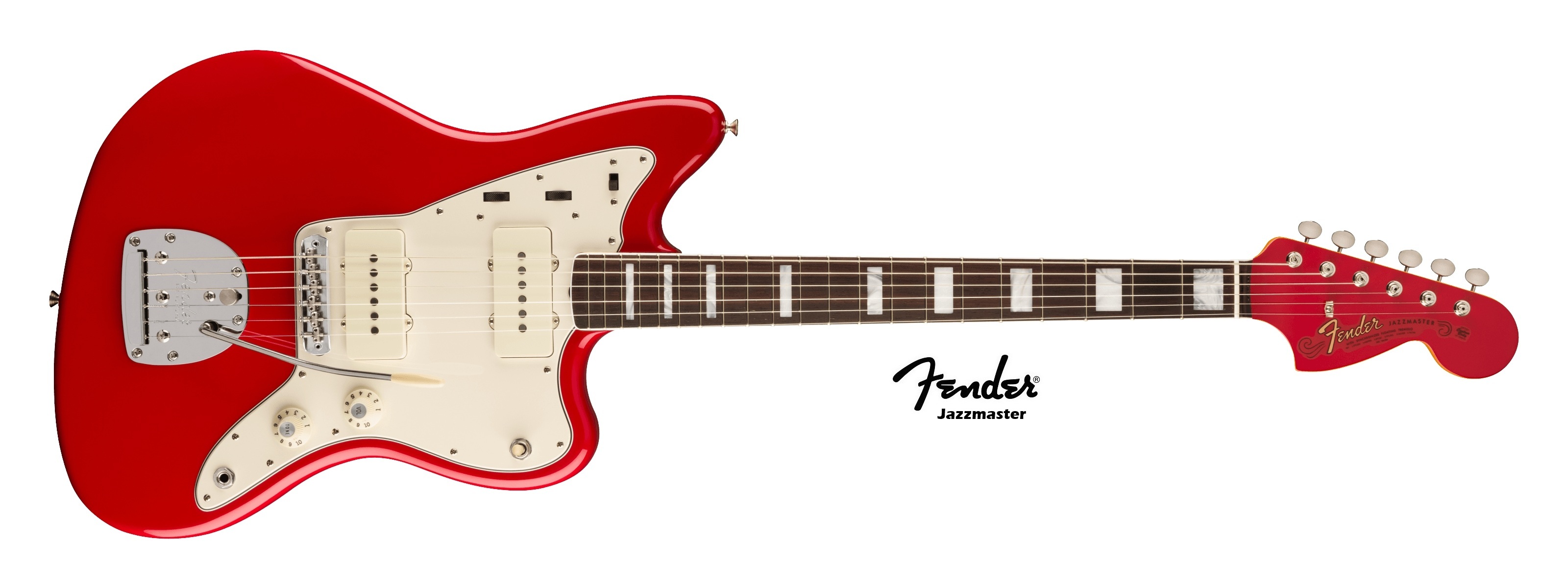
| Fender Jazzmaster |
| The Specs |
 Year:
Year: 2023
Builder: Fender
Series: American Vintage II
Model: 1966 Jazzmaster
Color: Dakota Red
Hardware Finish: Chrome
Serial Number: V2327656
Body: Alder
Body Finish: Gloss Nitrocellulose Lacquer
Body Binding: None
Cutaway: Double
Pickguard: 3-Ply Parchment
Bridge: Pure Vintage Jazzmaster
Tremolo: Pure Vintage Floating
Saddles: Threaded Steel Barrel
Fretboard: Rosewood
Fretboard Binding: 1-Ply White
Fretboard Inlay: Pearloid Blocks
Neck: Maple
Neck Profile: 1966 "C"
Neck Finish: Gloss Nitrocellulose Lacquer
Nut: Bone
Headstock: Color-Matched Jazzmaster
Headstock Binding: None
Headstock Logo: Gold Transition Fender Logo Decal
Tuners: Pure Vintage Fender Deluxe
Neck Pickup: Pure Vintage '66 Jazzmaster
Bridge Pickup: Pure Vintage '66 Jazzmaster
Pickup Switching: 3-Way plus Rhythm Circuit
Ryhthm Circuit: Neck Pickup Volume and Tone Thumbwheels
Control Knobs: White "Witch Hat"
Controls: Volume, Tone
Case: Fender vintage-style hardshell case
Body Size/Shape: Jazzmaster
Frets: 21 Vintage Tall
Fretboard Radius: 7.25"
Scale Length: 25.5"
Nut Width: 1.65"
Body Width: 14"
Body Depth: 1.69"
Strings: D'Addario ECG24 Chromes (11-50)
I love Fender guitars—for many years, I was primarily a Strat player—and I've owned quite a few Strats and Teles over the years. But until recently, I'd never owned—or even
played—any of their offset guitar offerings. Honestly, I found them rather unappealing aesthetically compared to the classic countours of the Stratocaster and the timeless design of the Telecaster. It also didn't help that none of the guitarists I wanted to emulate during my formative years played a Jazzmaster.
The first time I picked up a Jazzmaster might be the biggest gear-related "a-ha" moment of my life—and it was purely serendipitous. I was in a local music store to compare a couple of Fender Stratocasters, and as I was going back and forth between them this Dakota Red American Vintage 1966 Jazzmaster hanging on the wall nearby caught my eye and on a whim I decided to give it a try.
Two things immediately grabbed my attention about the Jazzmaster—neither of which will come as a surprise to long-time Jazzmaster players, since they're pretty much the defining qualities that Jazzmasters are known for.
The first thing that stood out was the sound of the Jazzmaster pickups. I've heard them described as very "hi-fi" sounding, and I agree that they're extremely articulate. There's a responsive clarity to them that sets them apart from Strat and Tele pickups in a way I didn't expect. In addition to being very transparent, there's also an open, airy, hollow quality to them that gives the sound a feeling of dimensional depth and width that differs from most single-coil pickups. When combined with spring reverb, it's easy to see how they became popular for surf and spaghetti western tones.
With the rhythm circuit engaged, I was also able to get a phenomenal jazz guitar tone. That shouldn't be surprising given the guitar's name—but for some reason the Jazzmaster never really caught on with jazz players. That might have more to do with the look of the guitar than the sound, however.
The other quality that really impressed me—and made me realize I needed a Jazzmaster in my collection—was the silky smooth tremolo (or more accurately, vibrato) system. I've always been a big fan of Bigsby vibrato systems on guitars for adding glassy-smooth shimmer to chords, and the vibrato on the Jazzmaster is every bit as smooth.